San Cristóbal de Las Casas. Chiapas, México
Exhibition by Gerardo K’ulej
at Espacio MUY
Code: a law; something written-in-systems; symbols; instructions for communicating
Figure: things that represent, communicate meaning, or signify through another symbol.
Maya: cultural invention
1.0: binary code; the mathematical revolution invention (Maya and non-Maya) of zero, upon which digital technology is based.
In traditional Western sculpture, the artist materialized their ideas in the form of stone; whereas the classic Maya wrote on stone as a kind of blank or white support. In contemporary Maya art, and with the work of Gerardo K’ulej, the stone speaks for itself and the artist’s job is to place the object so that the stone resonates through our senses. We may feel that we are ‘hearing” it in its own voice.
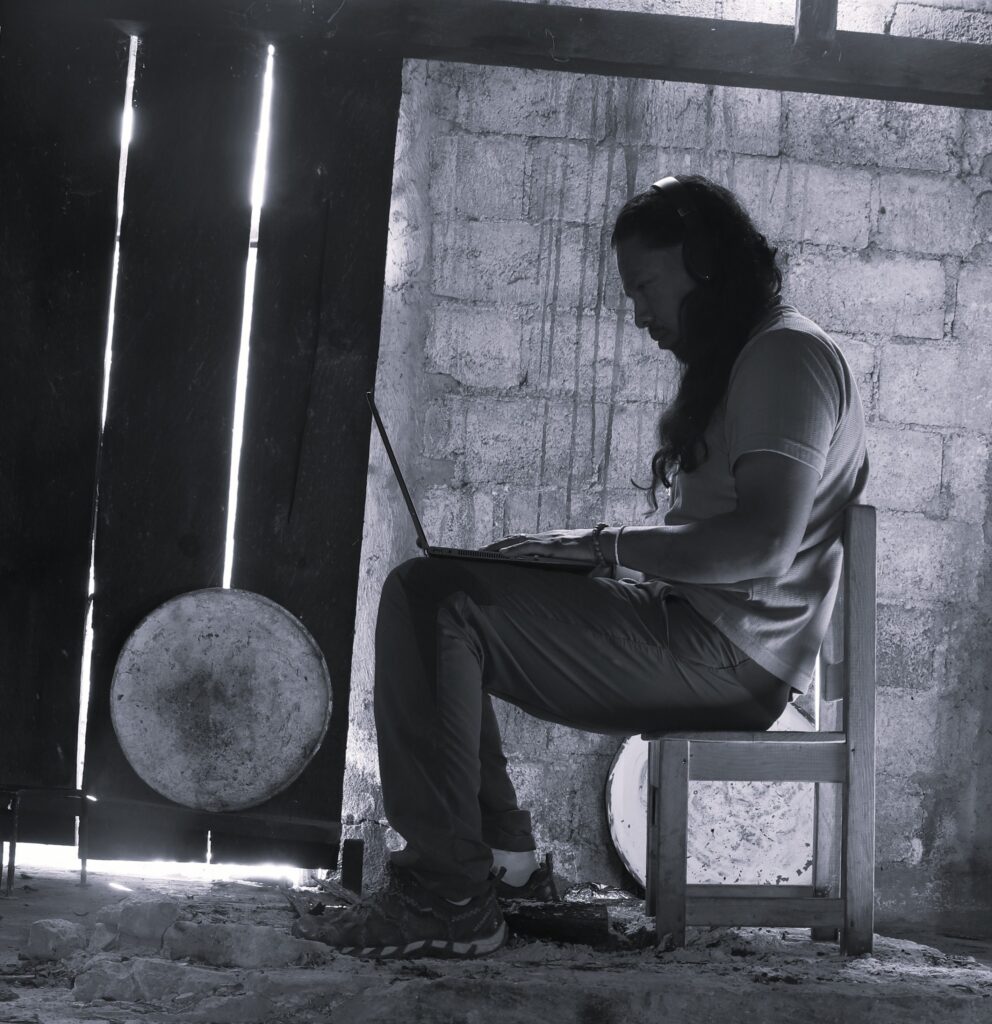
As we “hear” the material, we are also hearing the artist. Who is K’ulej? He is a man rich in reflections about being Maya, here and now.
Adventurous: he up and left familiar Ch’ilil at a young age without resources, driven to study the material world, made living: biochemistry.
Smart, with a mission: he completed a master’s degree, not to secure a salary but to appropriate Western science and mathematics to deeply understand – and contribute to – Maya knowledge systems (past, present and future).
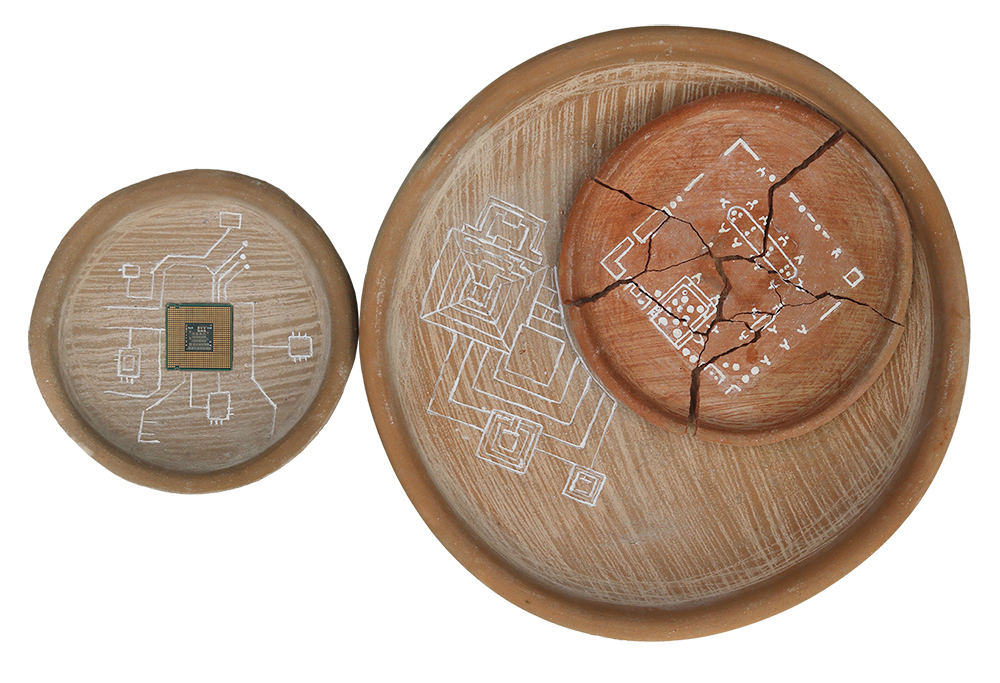
Grounded: without ever claiming to be one-who-knows, he formulates (assembles forms representing) his crystalized reflections, often – usually – with seriojocular wit in K’ulejian style. The juxtaposition of materials — the broken comal with her me(n)tal chip — is funnily iconoclastic neo-iconism characteristic of the playful creator.
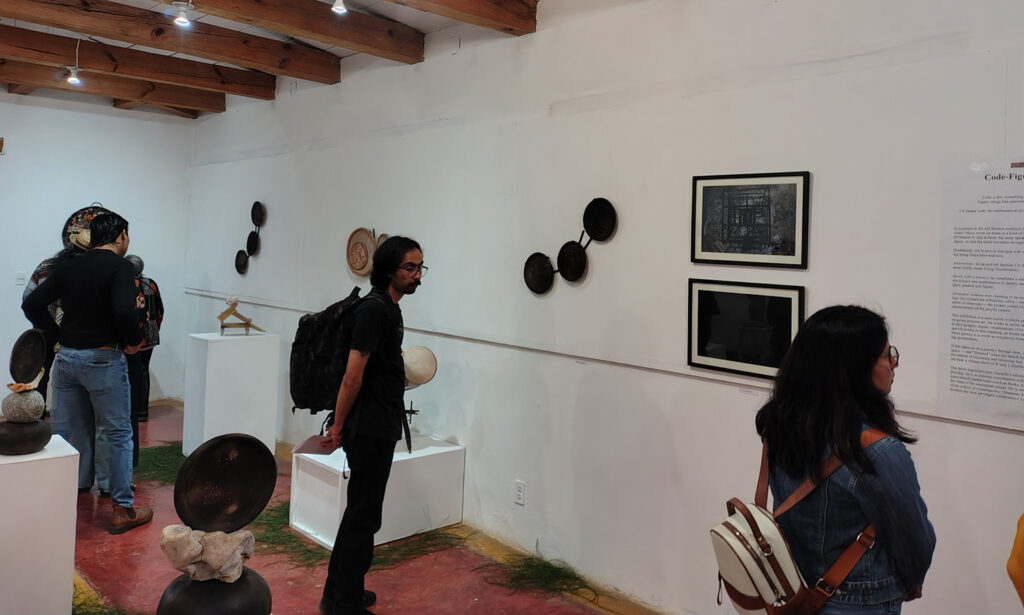
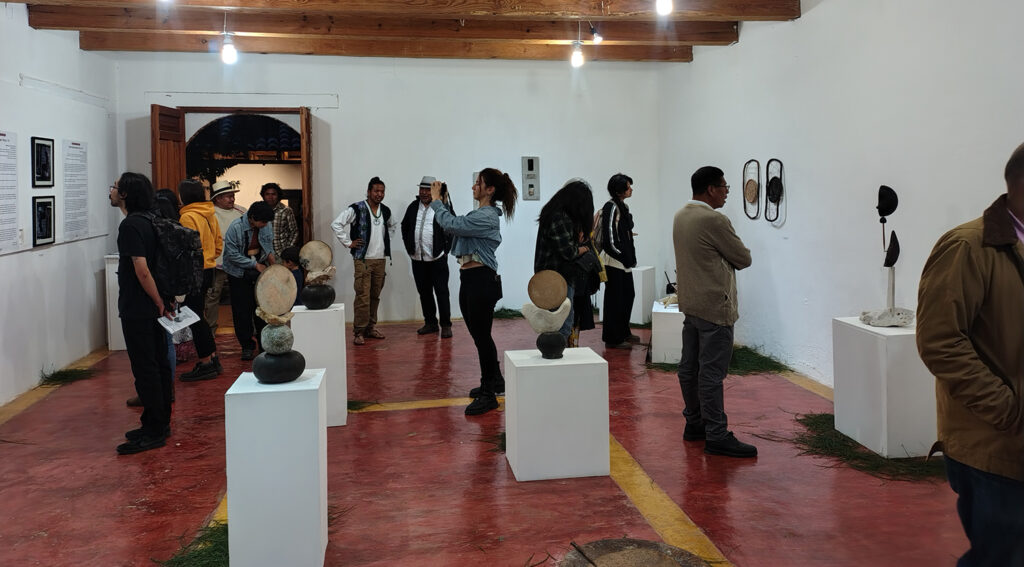
This exhibition is a semi-colon: a whole proposition carefully curated and a moment in K’ulej’s on-going process-art. He works in series largely defined by the medium: abstract sculpture, conceptual photography, digital visualizations of everyday life and his poetic-philosophical writing (linked to specificworks or free-standing, as found in the show’s catalogue) depict a beautifully cross-eyed Maya person in a world as complexly rooted in a past-present as in a present-future undergoing dizzying acceleration.
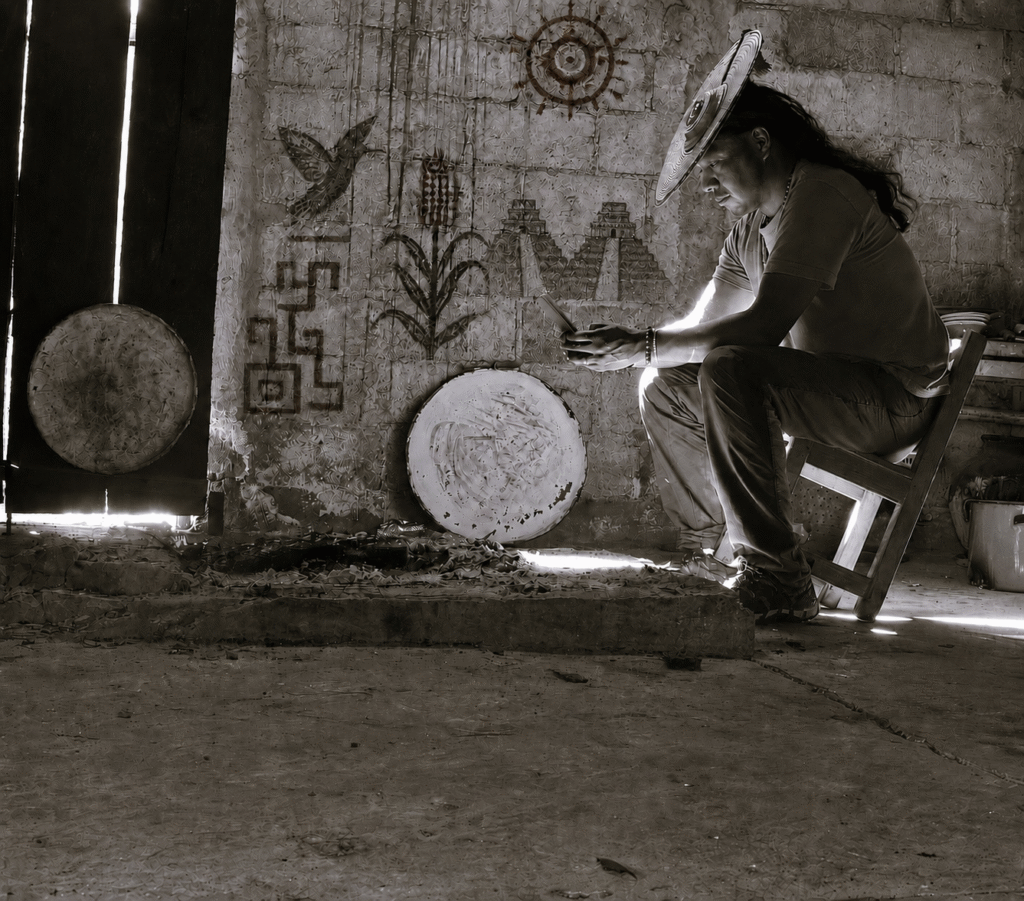
If this takes us on a journey through time, it is “backward” — when the stone hearth constituted real space — and “forward” when the hearth becomes real again through computational codes. It is a movement of becoming and returning that vibrates, faster and faster. Just as one feels vibrations, we see-hear a vibrant show of K’ulej 1.0(infinity).
One more important note: Gerardo’s artistic practice is uniquely social to the point that he aliases authorship. He’s in constant consultation with fellow artists (such as PH Joel, Darwin, Margarita) and intercultural intellectuals (such as Burka, Kees, Misgav and others); their conversation is folded into the masa of his conceptual pieces. He is one of the maestros of the collective authorship characteristic of the school of contemporary Chiapanec Maya art. As the art is dialogic in this sense, you as interlocutors are now privleged collaborators. Let Gerardo, and all of us, know what you think.
Espacio MUY
May–June 2026
- Inauguración
Obras
.com. al 1,0,1
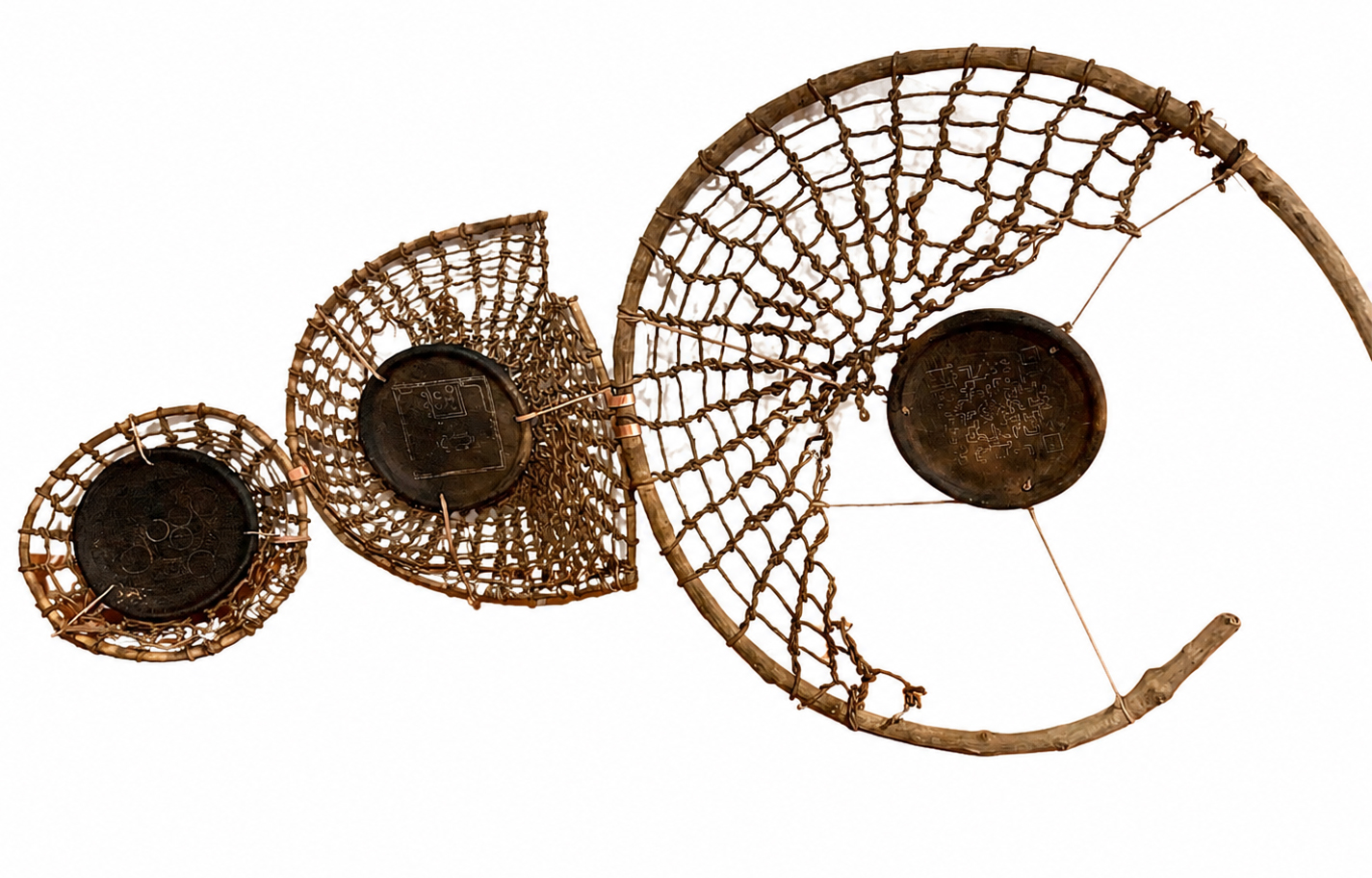
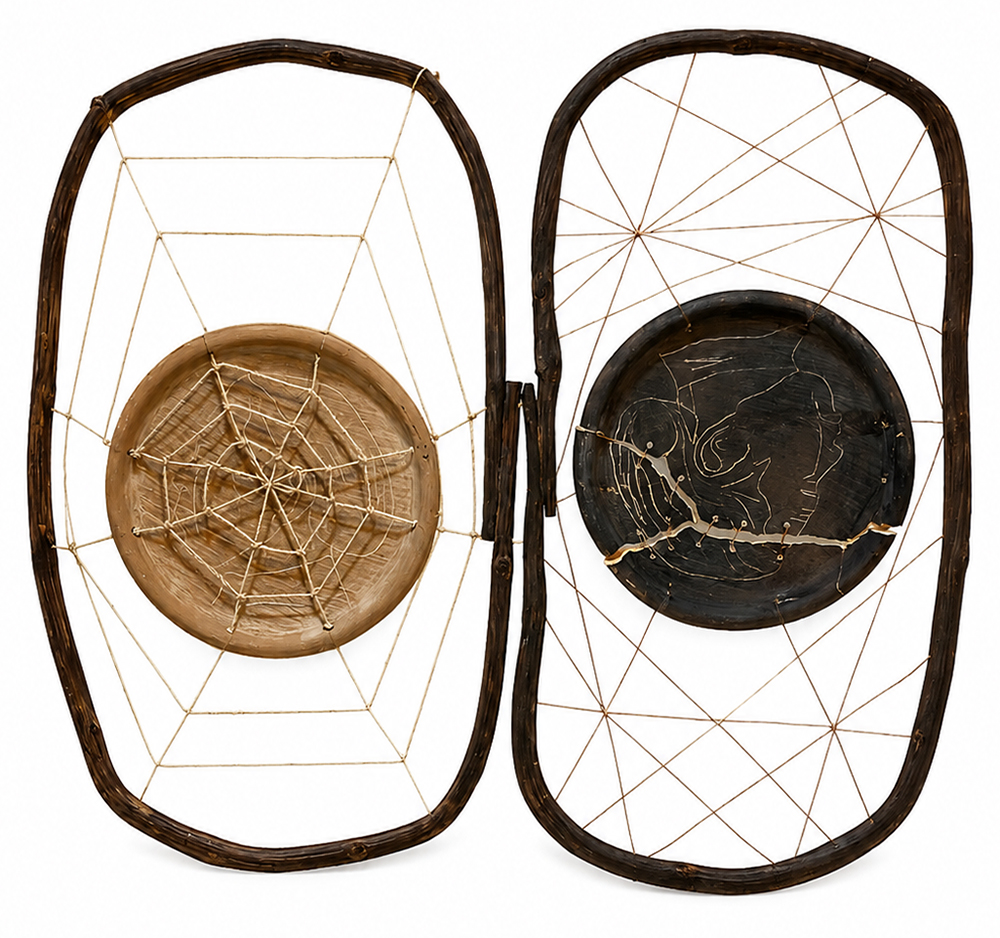
Organic network, wood, terracotta comal
130 x 68 x 68 cm
2025
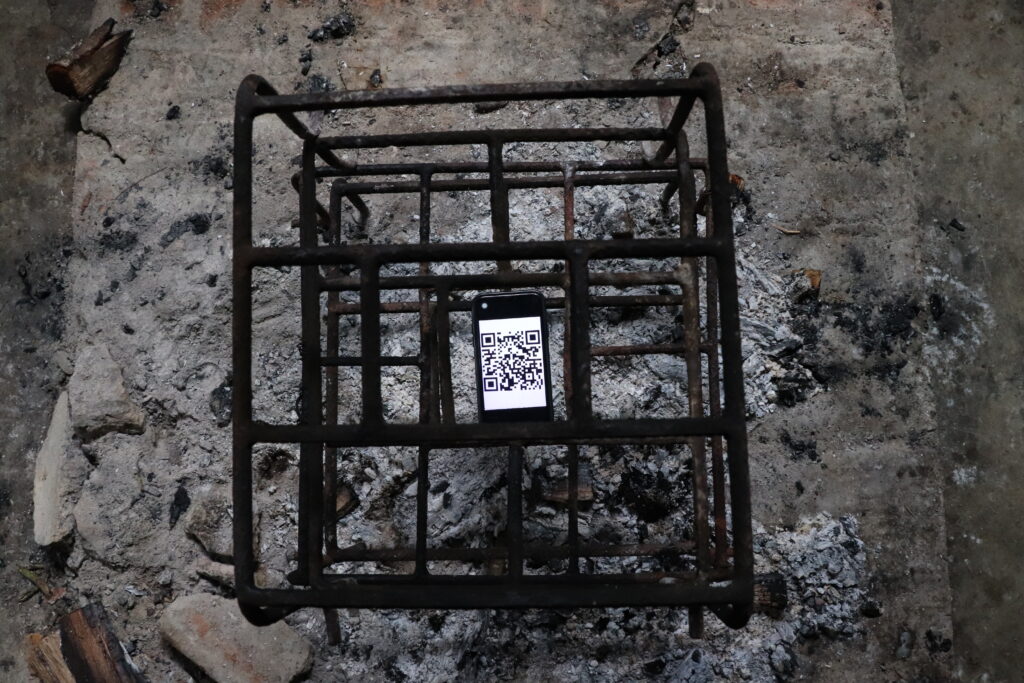
My future, which is already in the QR code; my present, which still resists at the hearth; my past, which is no longer my “Maya pyramid.”
Everything is within me, I am all of this, a process of trans-ition.
The networks where I exist: the past (traditional), a solid structure; the present (the modern), where the network begins to become open, non-uniform; the future network, broken and open due to drastic and ephemeral changes brought by communication technology.
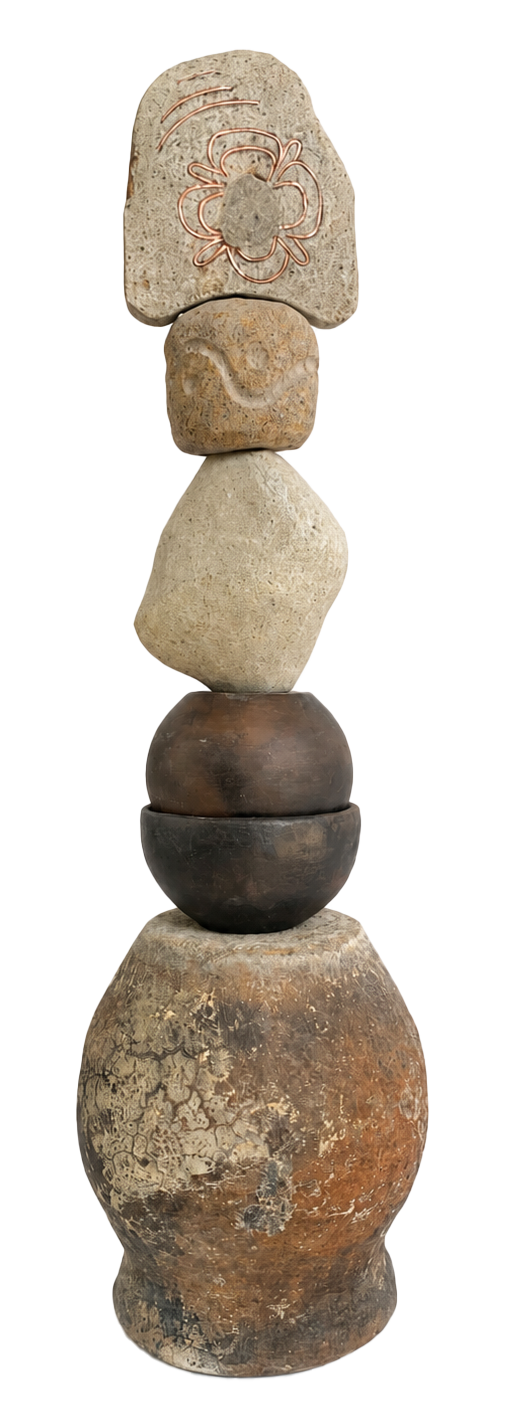
Yoketik
Terracotta pots, stone, copper.
60 x 20 x 20 cm
2025
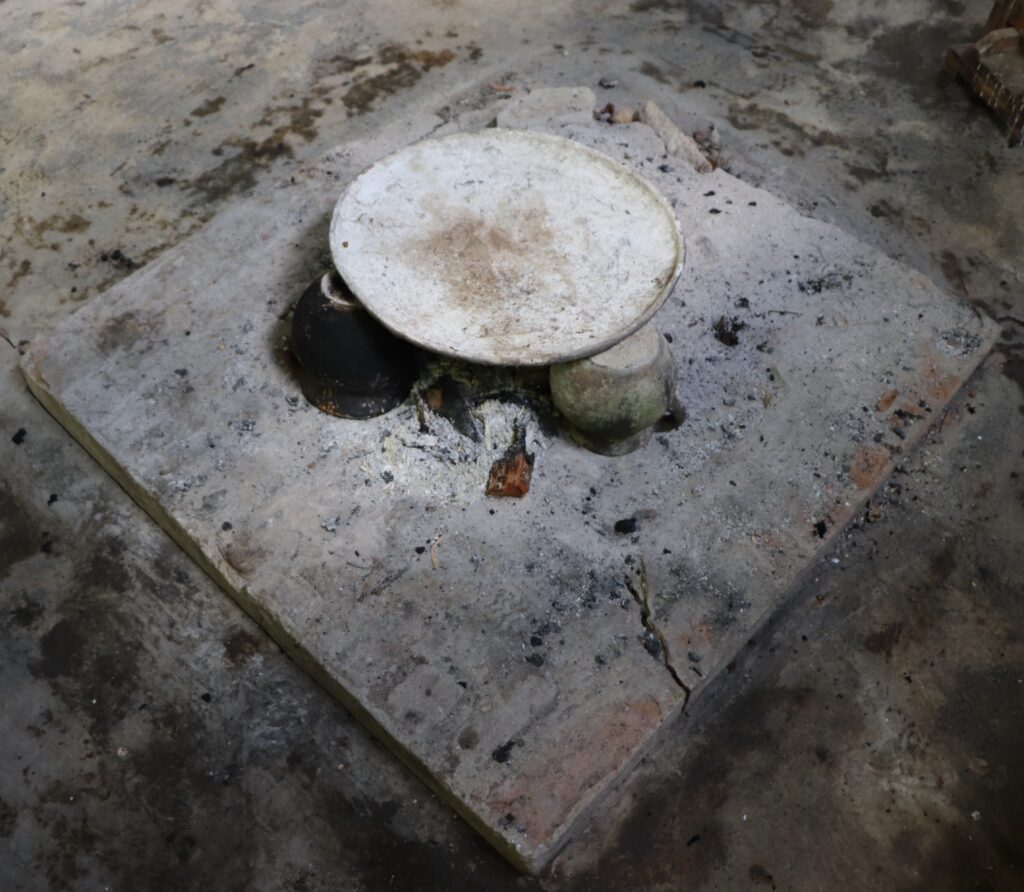
From the series Maya Code-figurations 1.0, this piece consists of everyday elements that were used around the hearth. The yoket (foot, base) used to support the cemet (comal).
Sometimes terracotta pots were used upside down as columns to support the comal. Terracotta was also used to make utilitarian objects, from small pieces for holding seeds to large vessels for storing liquids. Nowadays, these objects are rarely used due to the preference for metal pots and plastic utensils.
In the sculpture, the pieces are stacked, a vector pointing upward, like our foundation in our local environment moving toward the modern. The stone at the top has copper inlay, like that element which contains digital technologies or the wires that conduct electricity.
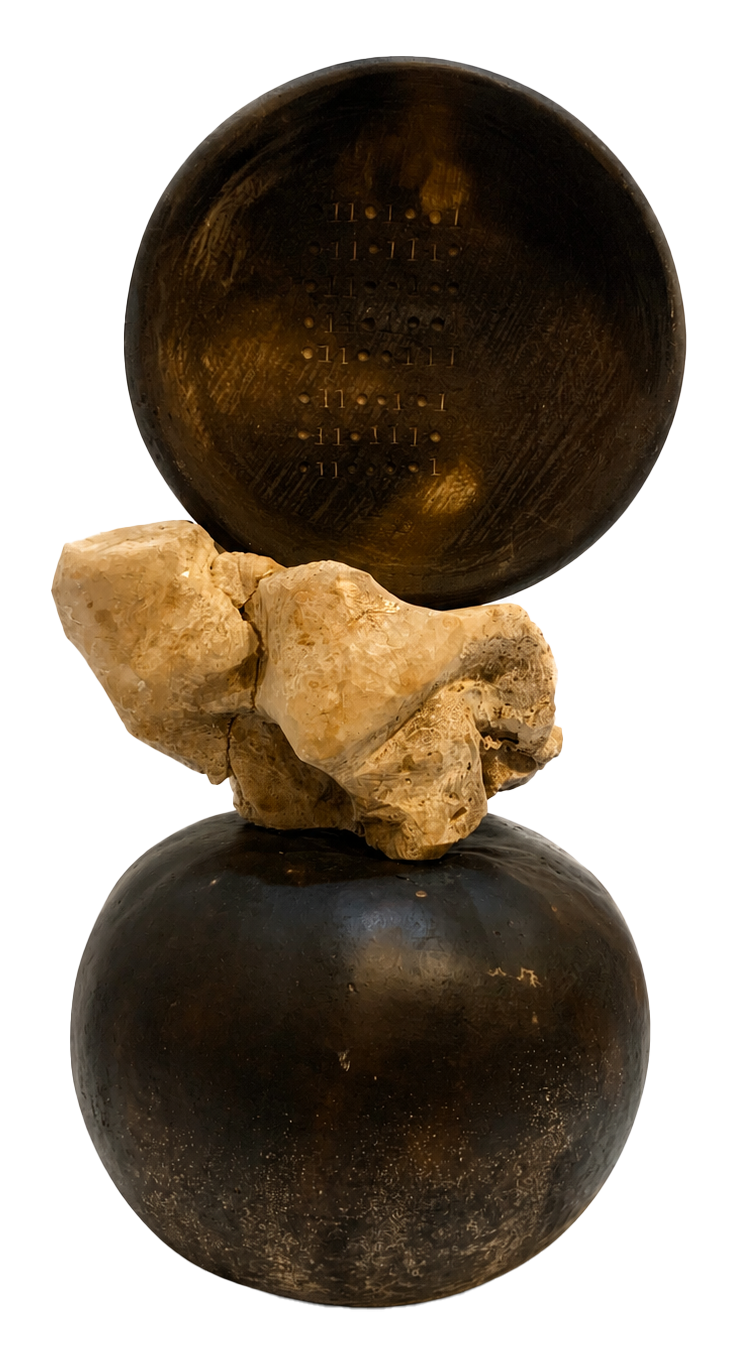
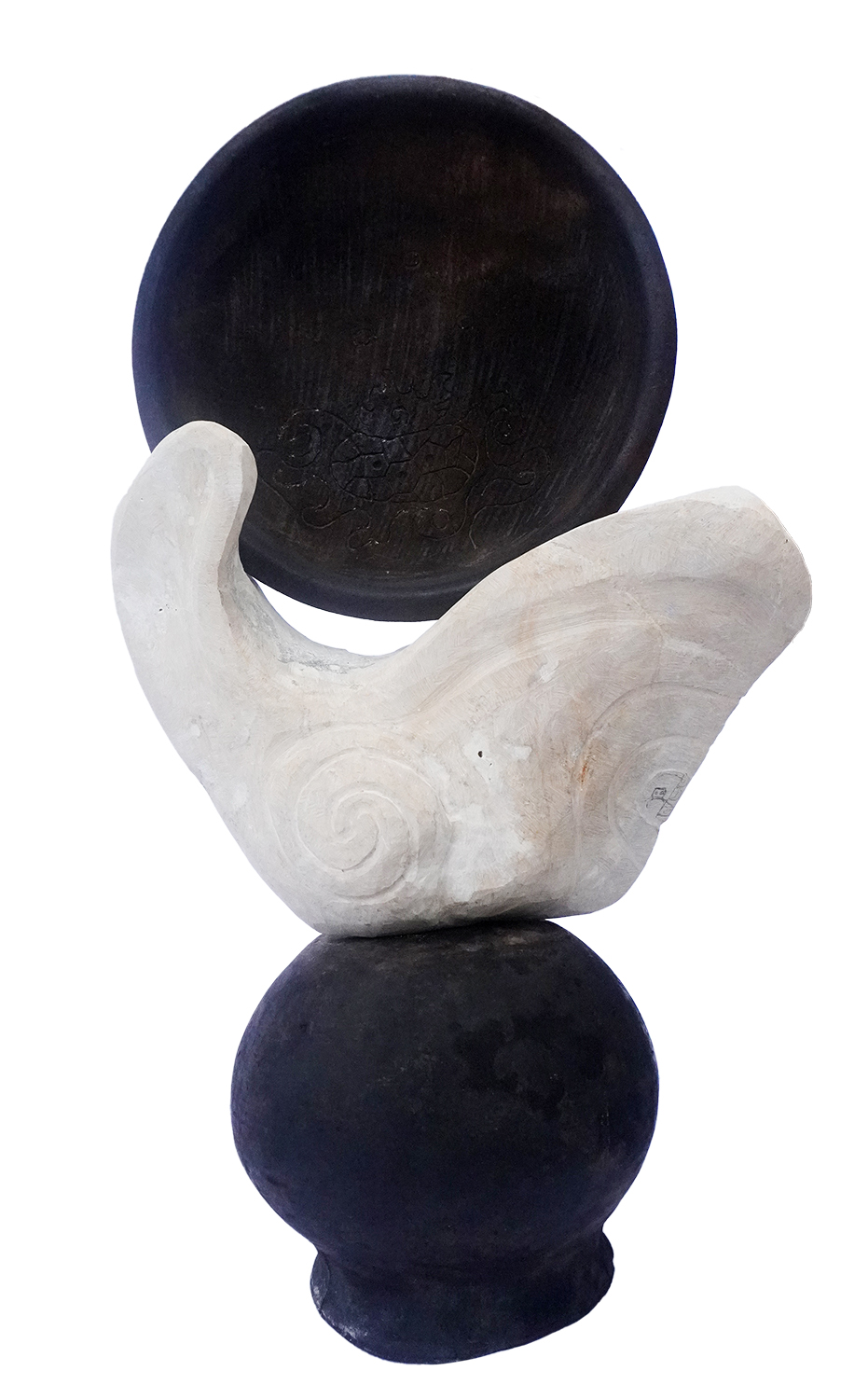
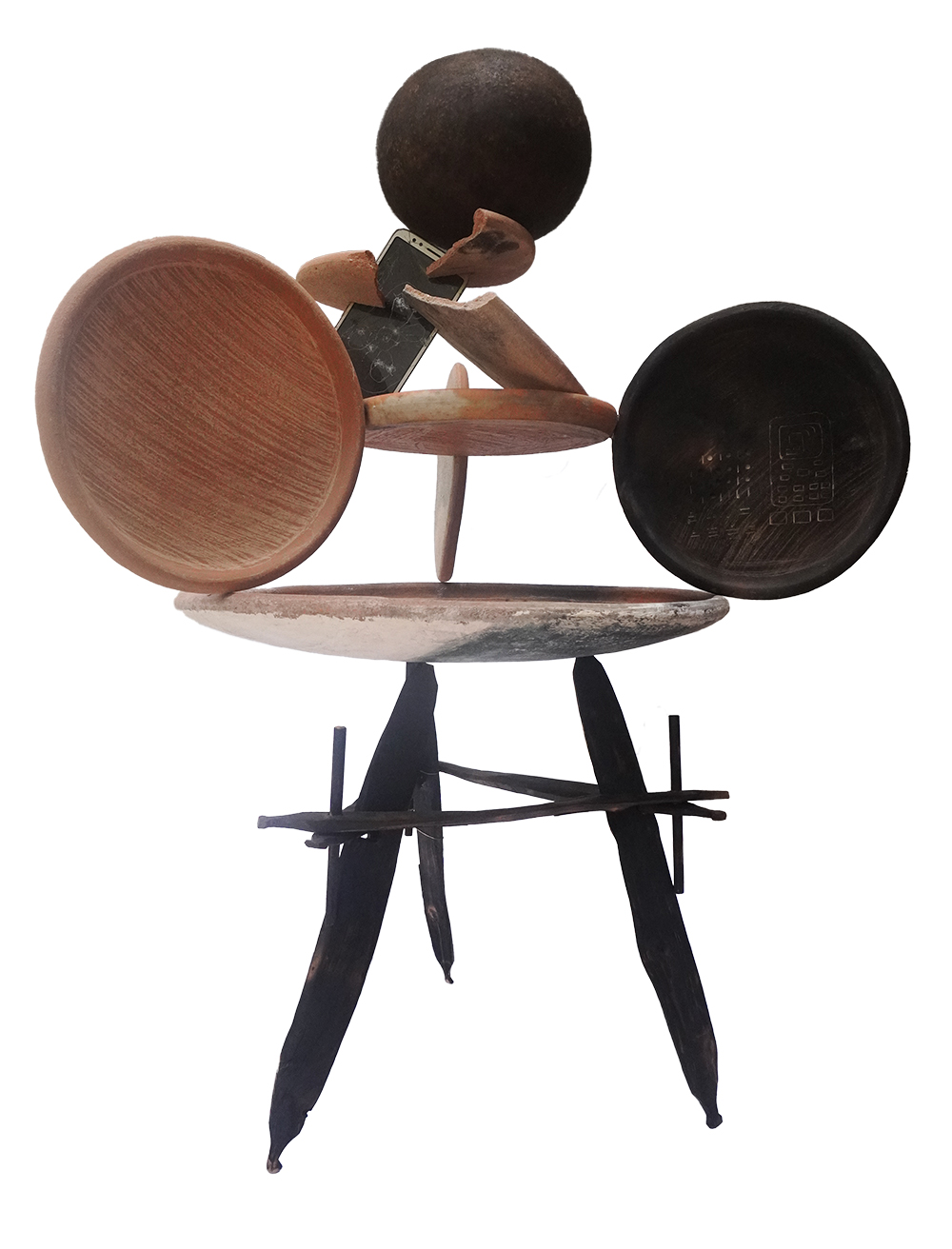
Binarismo
Tecomate, bax (quartz), terracotta comal
50 x 30 x 30 cm
2025
The tecomate, used to hold tortillas; the bax (quartz) stone, which is ground and mixed with terracotta to provide thermal resistance and efficiency — all these materials in a highly organic form, and forms of knowledge that have been shared from one generation to another. However, with current technological distractions, one often moves away from local knowledge in order to learn from the globalized world, entering into a language that is often incomprehensible, concerning the technology of codes, as they are written in a rather abstract language between lines and zeros (binary code) 1, 0.
The phrase written on the comal is in binary code, which, when translated, would read “indigenous.”
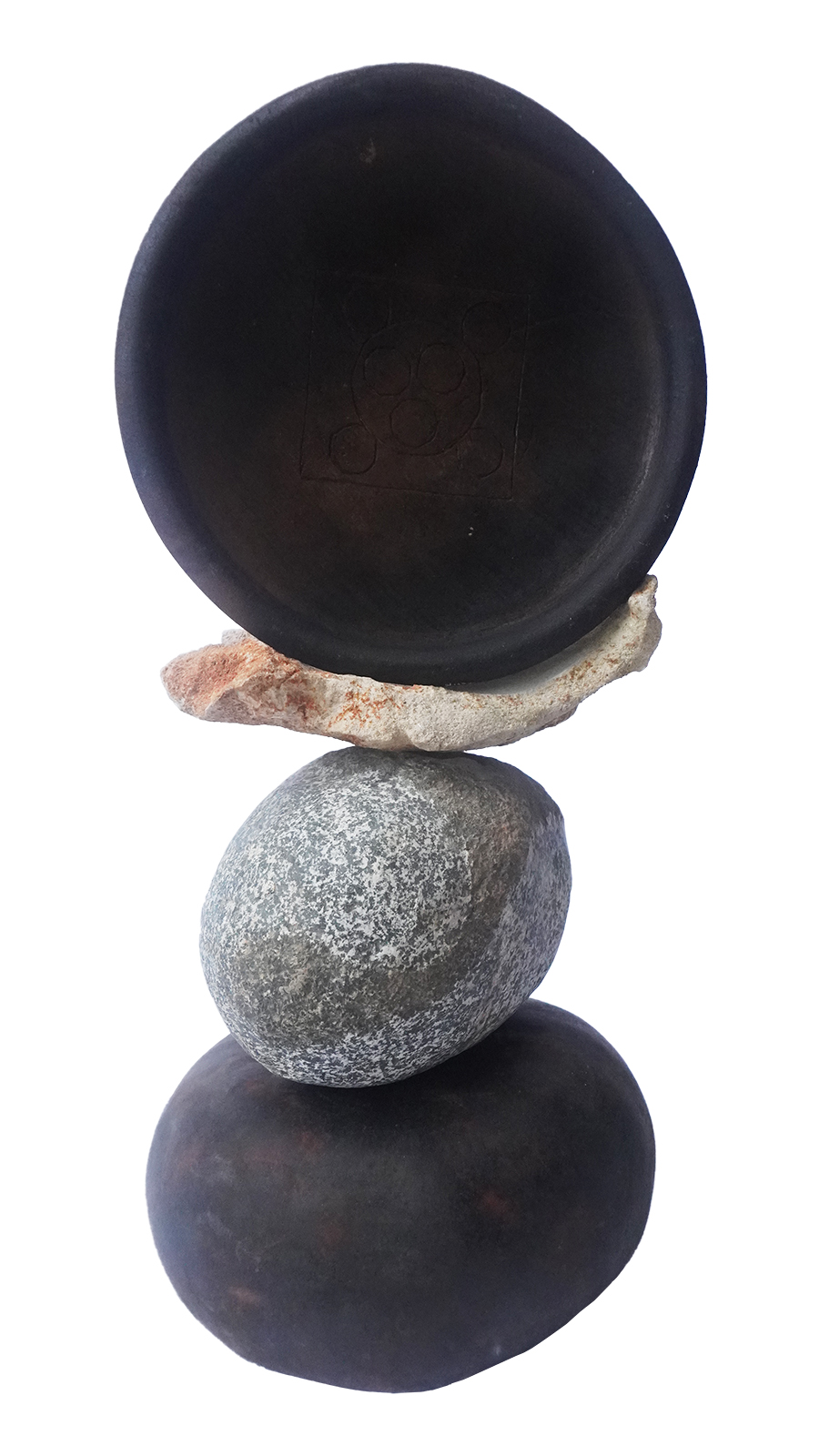
Glofo-fogon
Metate, stone, terracotta comal.
50 x 20 x 20 cm
2025
A timeline and of fragilities: the tecomate that holds the tortilla, which carries the stone; the stone as ch’ul ton (sacred stone), which at the same time supports the comal.
There is a glyph that represents the hearth. At the same time, I represent the four universal directions, and how the tortilla has become globalized and forms part of capitalist consumption, as well as the modifications or alterations we now use in making milpa.
Yoket K'anal
Terracotta pot, stone, and terracotta comal.
50 x 35 x 16 cm
2025
The upside-down pot is pouring out its knowledge from the past.
A pot that is the yoket (the pillar, the column) that supports “Orion,” the three nocturnal stars visible when the light of modernity fades, stacked like columns in alignment.
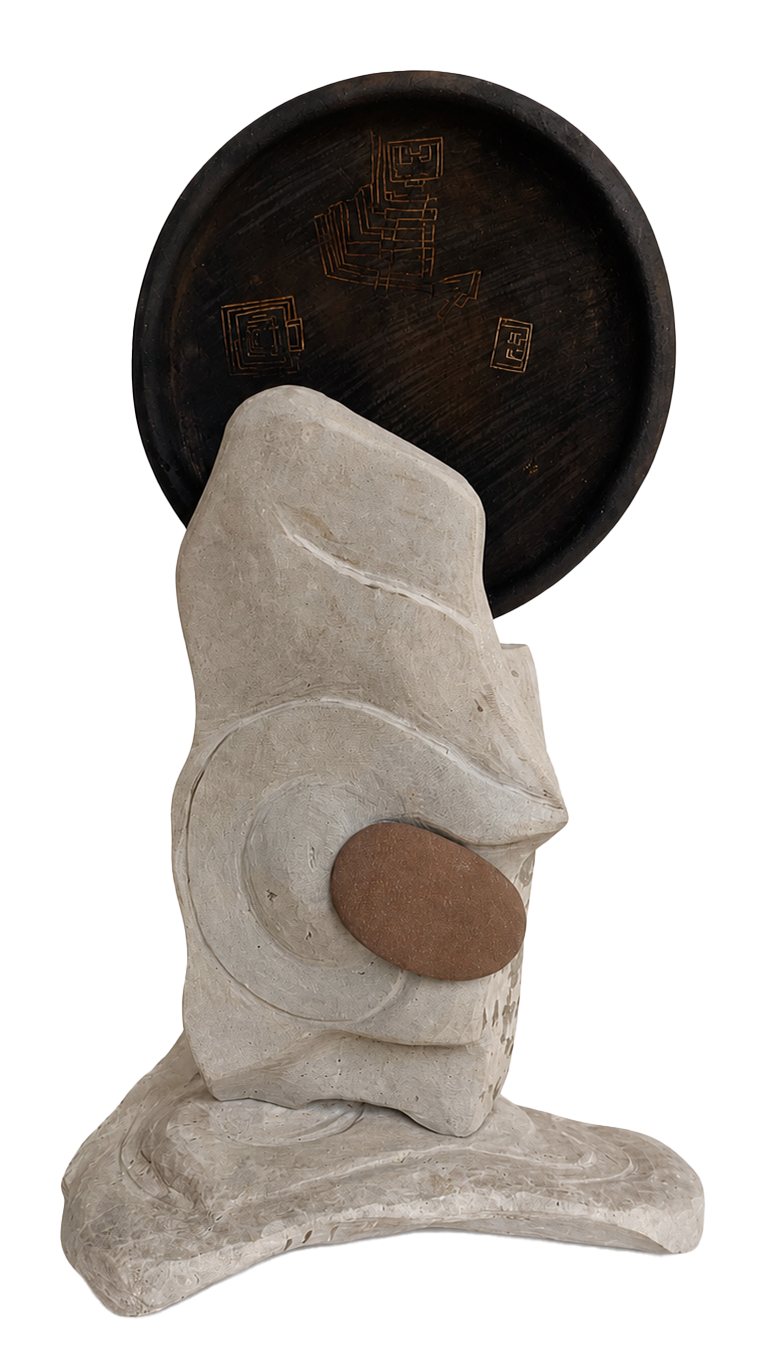
Ch'ul K'op
Stone and terracotta comal.
50 x 40 x 20 cm
2025
It is said that I am Maya, but when I go to sacred spaces, archaeological ruins (Ch’ul vitsetik), and see the glyphs, I cannot decode them.
I belong to the time of the hearth, which I decode, where there are oxim yoket (three stones). What does three-stones mean? I made an interpretation of a glyph from oral tradition, something like a word that flows in the wind, cyclical, until there was an interruption. The glyph carries a comal (of terracotta) encrypted with three elements that represent the three temples in Palenque: the Temple of the Foliated Cross, the Temple of the Sun, and the Temple of the Moon (something like the oxim yoket).
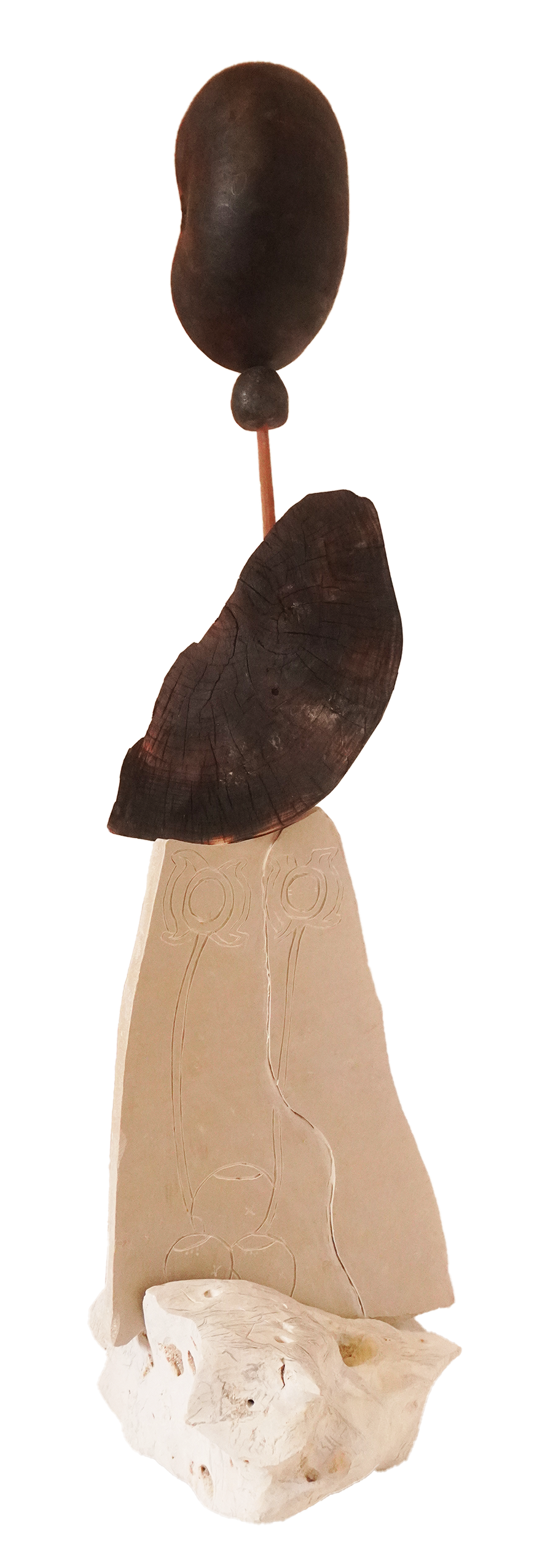
Ch'ul Vits
Stone, wood, tecomate.
84 x 30 x 40 cm
2025
Where does my oxim yoket (three stones) of the hearth come from?
This piece refers to the Maya worldview of the constellation “Orion,” where astronomical study began and cycles related to maize were created, all thanks to the astronomical sages who precisely followed the stars. Perhaps today we have forgotten the practice of being amazed by the darkness in order to see the constellations, or perhaps it is more the light pollution of modernity — from cell phones and streetlights. It has made us forget to see beyond a screen or a paved ground.
It symbolizes the abstraction of a turtle carrying the three columns that support Orion.
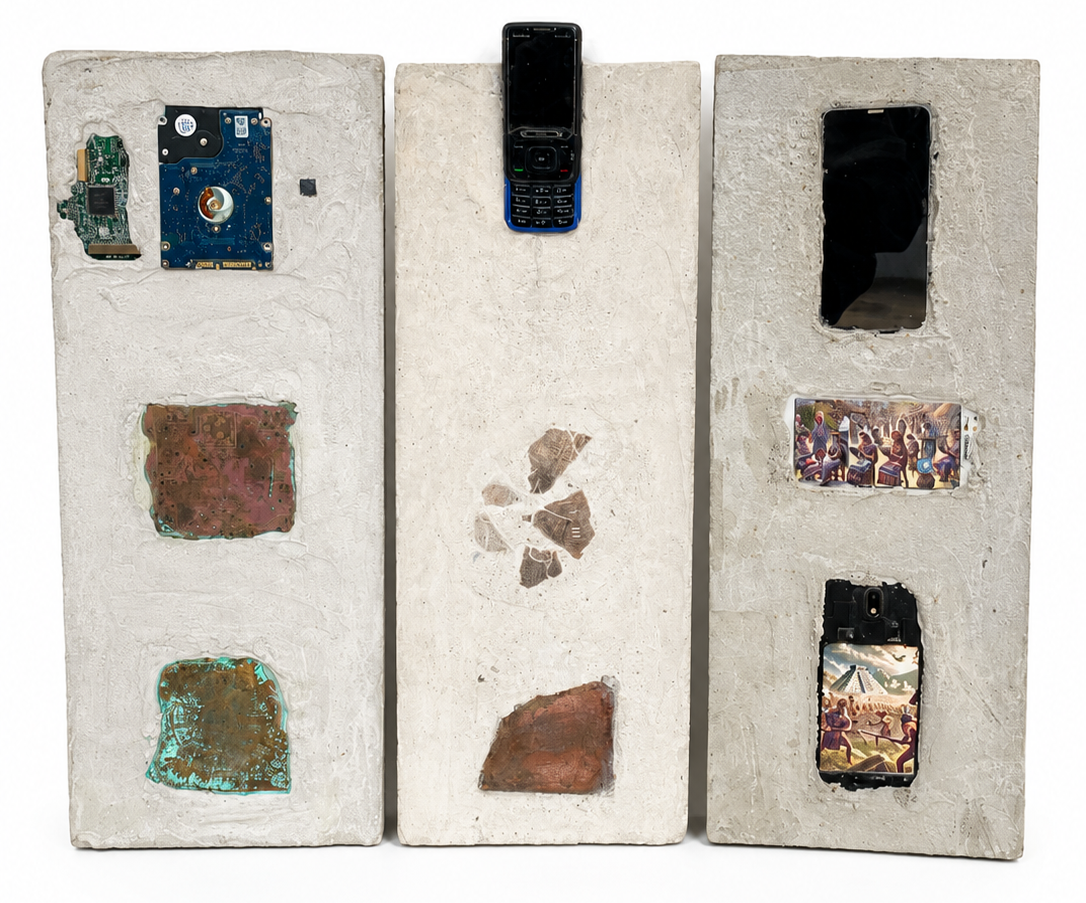
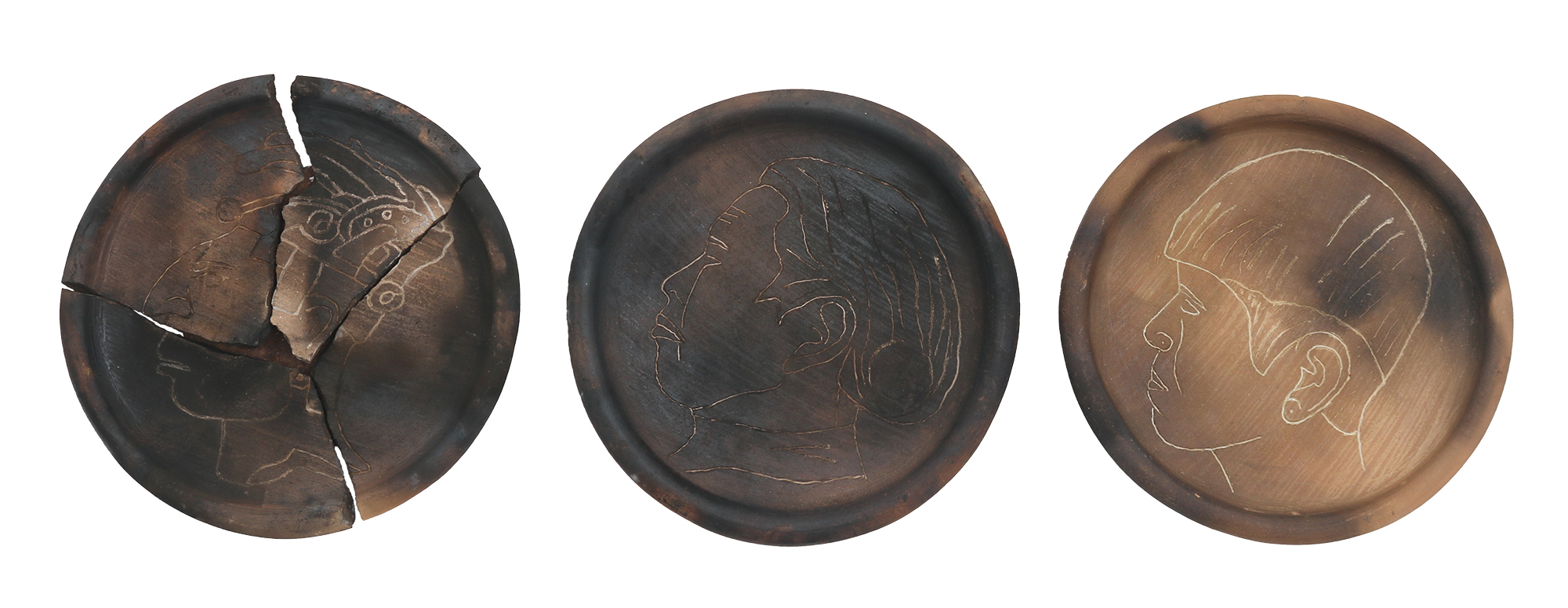
Stele plates of time
Concrete, PCB board, cellphone, motherboard.
51 x 21 cm c/u
2026
To rediscover among the “concrete” of existing forms and ways of thinking that have been defined through other perspectives or positions is like digging into that solid structure that has remained in the past, exists in the present, and reverberates into the future. These are the symbolisms where I coexist, the trans-passing from the ancient Maya, to the hearth, and to this technological–symbolic era, which over time becomes objects of archaeological relics for the future. But certain social–communal practices have been altered. Although technology appears to be highly useful in our daily lives, there are elements or internal structures that, in some way, we do not control, and this lack of control has made us easy prey to consumerist technology.
Between lines and networks
Terracotta, natural fiber, copper wire
55 x 30 cm
2026
Coexisting in multiple worlds,
Between the traditional and the modern–global.
They are networks of intercommunication.
Between the traditional, a more organic–hermetic flow in certain occasions,
And the modern, everything ephemeral, where all is stretched with network lines
Of telecommunication covered in copper, invading with information between the real
And the virtual. It is like fragmenting oneself, it is like cohabiting a quantum space of the ch’ulel.
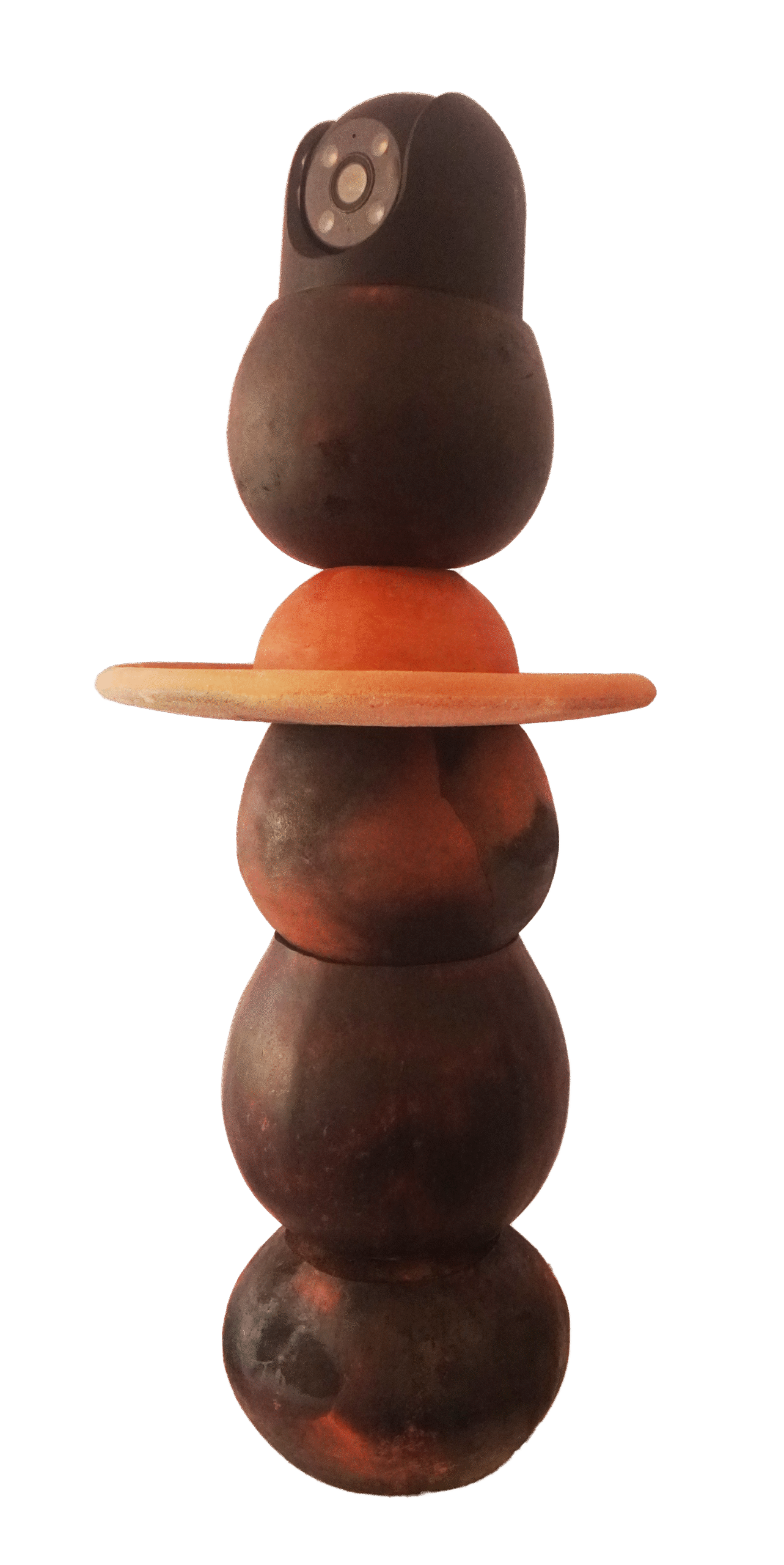
Chinam tak’in
Terracotta pots, tecomate, and surveillance video camera
66 x 30 x 30 cm
2026
The uncomfortable gaze: a gaze that is not real but virtual, technological, when we use a surveillance camera. I remember that in childhood, in community homes, the house might have had a door, or perhaps nothing at all. Yet insecurity was neither felt nor imagined. But over time, we began adding elements that seemed to provide security, such as locking the house, with the idea of being protected or preventing someone from entering. At what point did we begin following this tendency toward the privacy of spaces in order to feel safe?
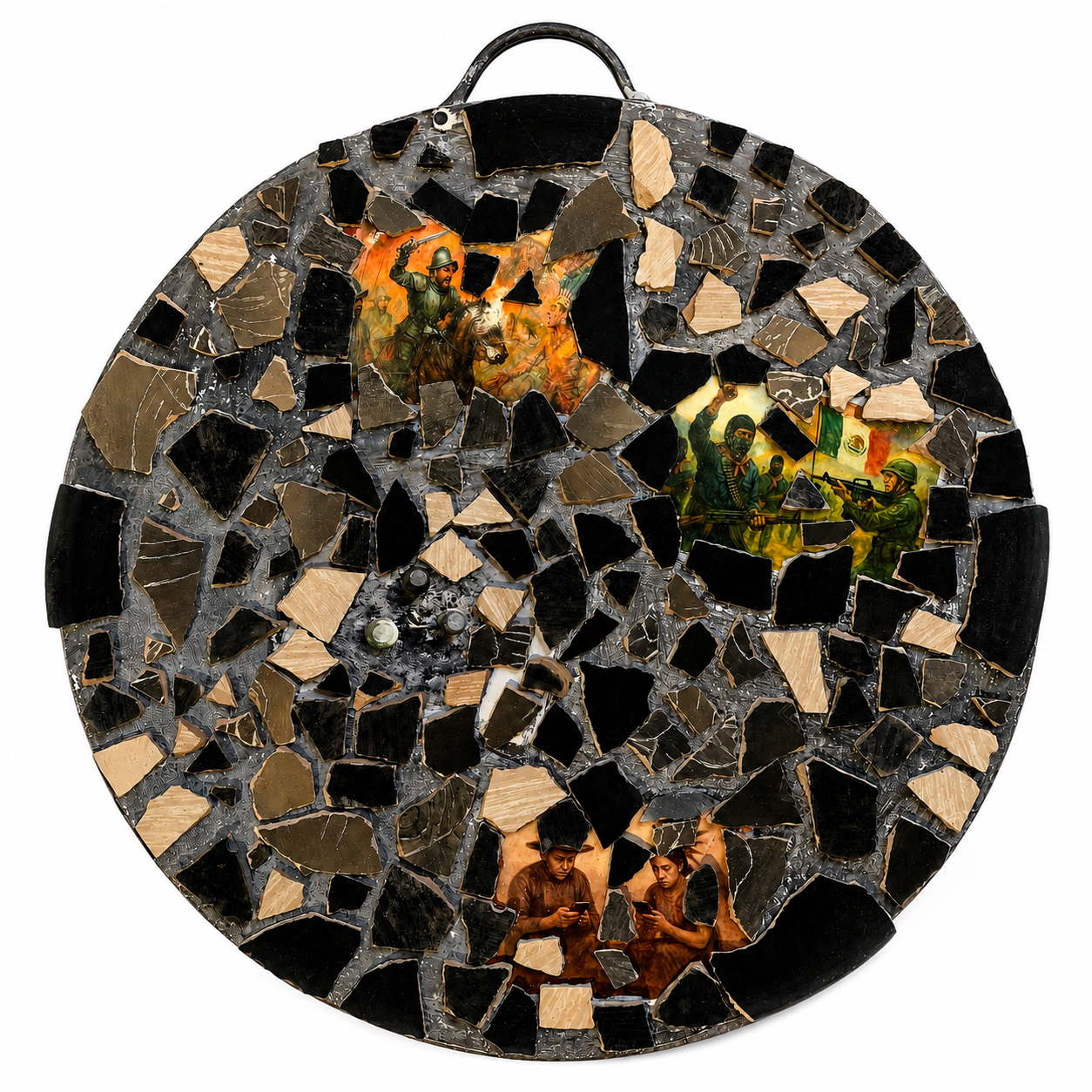
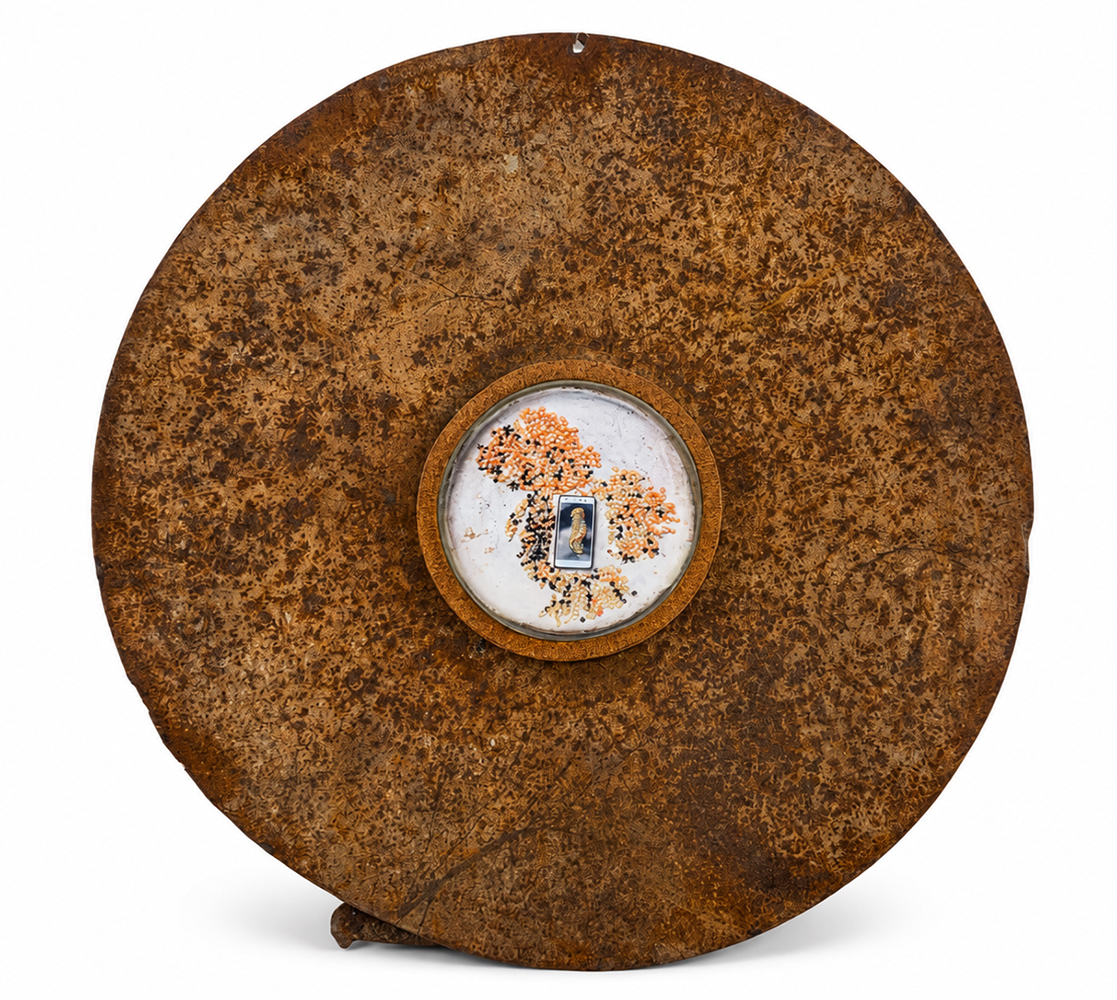
Big-bang Chiapas
Collage of broken terracotta comals and AI-generated images on a metal comal
Diámetro de 53 cm
2025
I am from Generation Z, who grew up in the Chiapanecan big bang of colonialism, the revolutions of Zapatismo – technologism – neoliberalism, the so-called globalization. We are the living metaphor that strikes us like kicks, the metastasis of the great acceleration of our communal – post-communal life, the alteration of traditional life.
Mi lum, mi otro lum y el lum-global
Ceramic, terracotta comal
56 x 35 x 7 cm
2024
Lum, in Tsotsil, carries deep meanings of land, territory, and the spiritual center of the Indigenous people. My lum is no longer my lum; it is a fragmentation of my intimate–communal space, where the Maya is never truly Maya. We are “Tsotsiles” with new ways of creating and making milpa-life, where the hearth is displaced from the center of the home, where oral dialogue around the hearth is no longer possible — it is better with the ch’ojon tak’in (or the cellphone): communication at a distance, and distant.
603,1988,2001
Ceramic, intervened terracotta comal
70 x 23 x 3 cm
2024
Code that fragments the ideal of the Maya as an established concept, identity, or static culture. The semet (comal) as a circular (and spiral) artifact that turns through time, through memory, yet within the same territory, although in different eras/contexts. We are Maya of cities with towers, and not of pyramids.
603,1988,2001 (2)
Ceramic, intervened terracotta comal
70 x 23 x 3 cm
2024
Code that fragments the ideal of the Maya as an established concept, identity, or static culture. The semet (comal) as a circular (and spiral) artifact that turns through time, through memory, yet within the same territory, although in different eras/contexts. We are Maya of cities with towers, and not of pyramids.
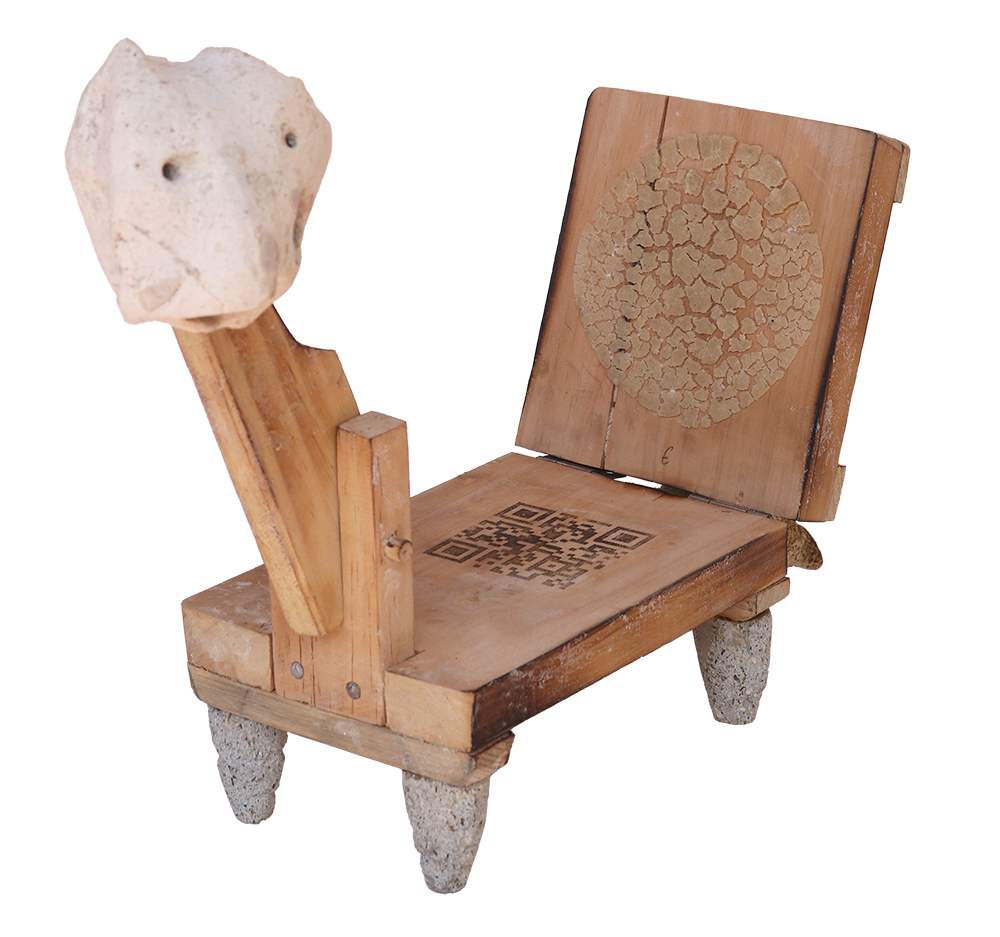
Pukujil-00000
Wood, stone, corn cob, corn dough.
50 x 35 x 14 cm
2025
Pukujil is like evil, but of something hidden. The piece is a masa press adapted to create a QR code. (The QR code takes us to a video about the press itself.) The piece has the shape of an animal (which is a pukuj). It is a memory, or the connection between physical space and digital space. Where is memory?
My pukujil has been transformed into a tool to reinforce my memory. The alloy of corn dough, wood, and stone is a technology that leads me back to my people.
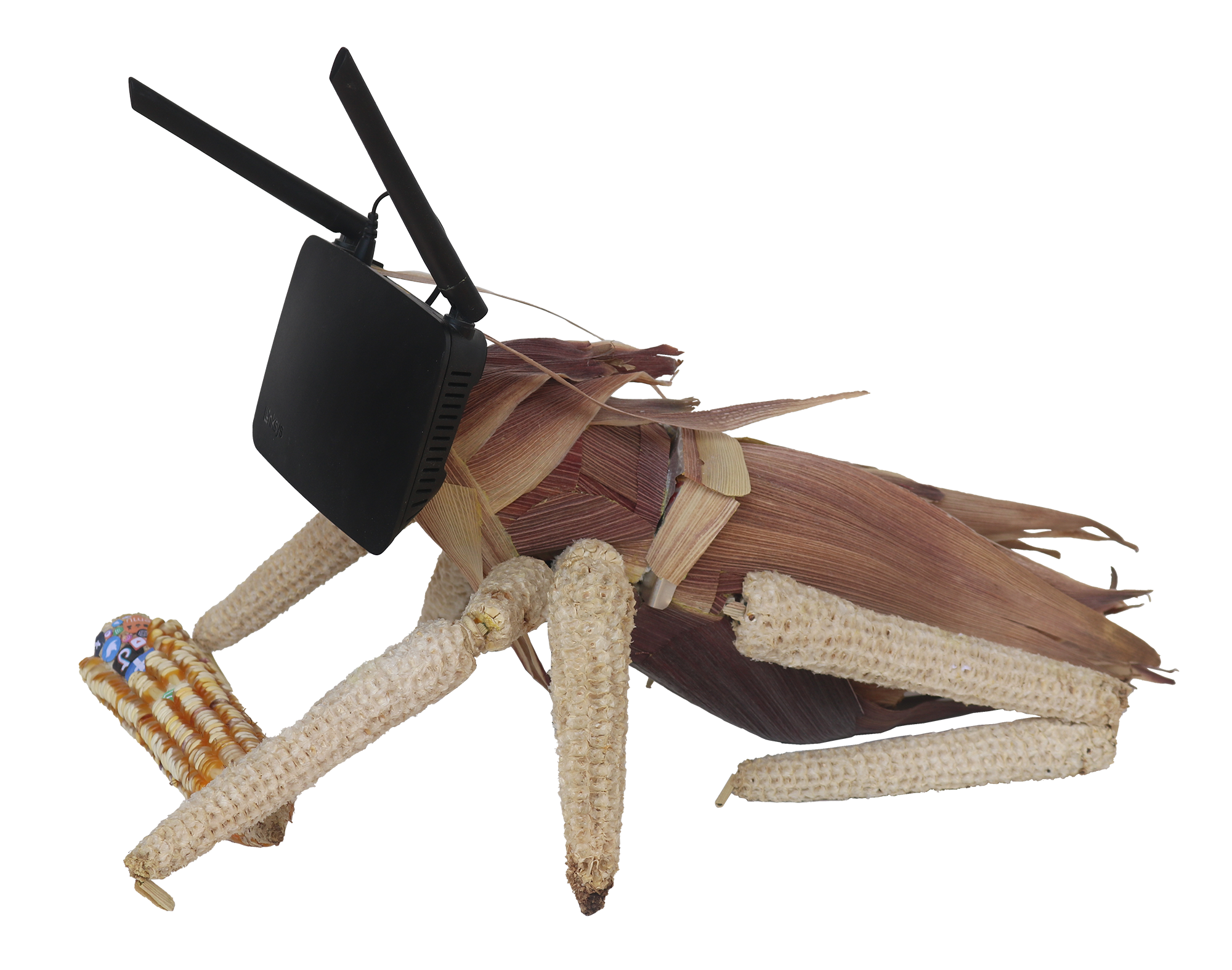
P’ilix bite (salta monte/grasshopper)
Corn leaves, corn cob, repeater, and corn.
65 x 35 x 38 cm
2025
(In the communities, internet companies are arriving, and one is called Bait or “bite.” From there comes the play on words between bit and the pests that destroy the milpa.) From this sculpture shaped like a cyborg-grasshopper, I engage in dialogue about the identity disruption that technological devices have caused in Indigenous communities.
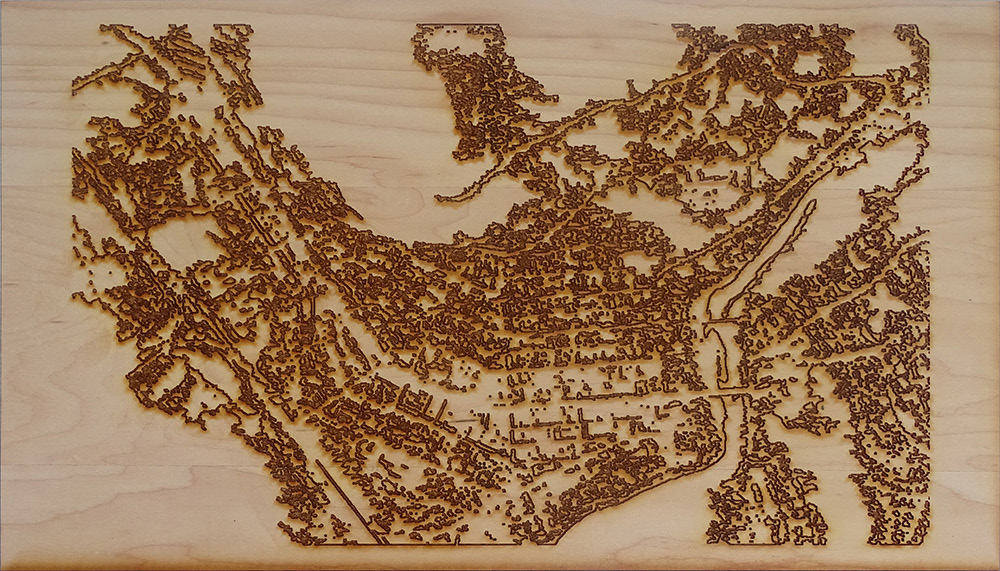
Banff
Laser print on wood.
35.5 x 52.5 cm con enmarcado
2022
It is a piece that forms part of the Lum-Global series, a theme that addresses globalization and the great acceleration of changes in communities brought about by the technological and digital era. These are two mappings developed with an “organic growth” algorithm, using a digital program, contrasting two complex worlds. Allowing me to leave a map of my community and compare the effects of urbanization in the future. Project developed at the Banff Centre for Arts and Creativity.